

Reframing a stalled feature to increase adoption +65% in 20 days
How I brought content design to a fast-growing SaaS team
+65%
New users who tried Workflows
+47%
Setup completion rate
20
Days to measurable lift
Calendly + SaaS + B2B + B2C + content-first design + design-led growthThe challenge I inherited
Calendly had launched Workflows — a new capability to automate what users do before, during, and after meetings — betting it would drive engagement. The bet wasn't paying off. Users weren't discovering it, the terminology didn't translate, and the flow leaked at setup. For the feature to work, users had to be able to discover it, understand the value, set it up without friction, and trust the outcome. The product wasn't delivering on any of those four.
I joined as Director of Content Design to diagnose why the launch had stalled and build the operating model that would unstick it — not just for Workflows, but for every feature release after.
My contribution
I was hired as Director of Content Design, to:
build and lead a team of content designers who also conduct research and lead ideation sessions for enhancements
introduce design-led growth, storytelling, and content-first practices
collaborate with UX to envision and execute a UX strategy
help increase adoption and engagement
What I did
I was hired to fix a specific launch, but the real deliverable was a content design practice Calendly could apply to every feature afterward. In my first months, I:
Built and led a content design team responsible for research, ideation, and messaging strategy — not just copy
Introduced design-led growth, storytelling, and content-first practices as standard operating procedure
Partnered with UX leadership to co-own the strategy for the Workflows experience end-to-end
Set adoption and engagement lift as the success metric that Content Design would be accountable for
The operating model I installed
Rather than patch the launch, I set up a repeatable eight-step model the team could run on any feature. Workflows became the first proof point.
1
I introduced a content and UX strategy brief as the starting artifact
Every engagement now opens with a brief that articulates business goals, user goals, stakeholders, existing insights, research questions, and the strategy in summary. It forces the team to frame the problem before designing anything, and keeps Design, Content, Product, and Research aligned on one version of the truth.
2
I ran a heuristic review of the existing release
Before talking to a single user, I needed a baseline read on what the experience was asking of people. The review surfaced the obvious issues the team could fix immediately and pointed to the harder questions worth testing.

3
We usability tested the live experience
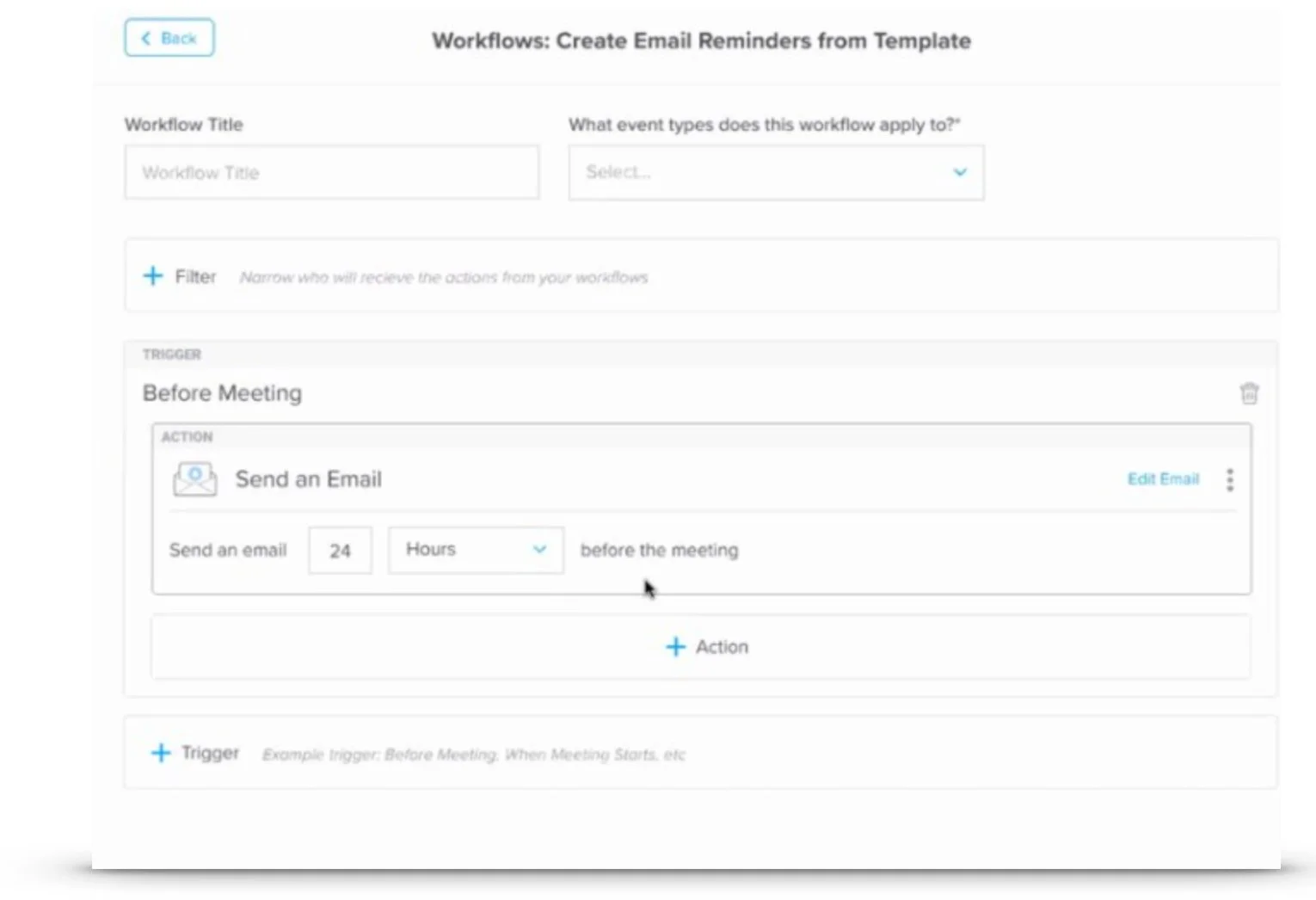
My team ran studies on the shipped flow. Users couldn't explain what Workflows were, couldn't articulate the value, and couldn't translate "triggers" and "variables" into anything they recognized. The mental model was the problem, not the UI.
4
I reframed the problem as a language problem and tested new concepts
I had the team explore alternative terminology and mental models, then test them with non-Calendly users — a harder bar than testing with existing fans. The language that survived became the spine of the new experience.
5
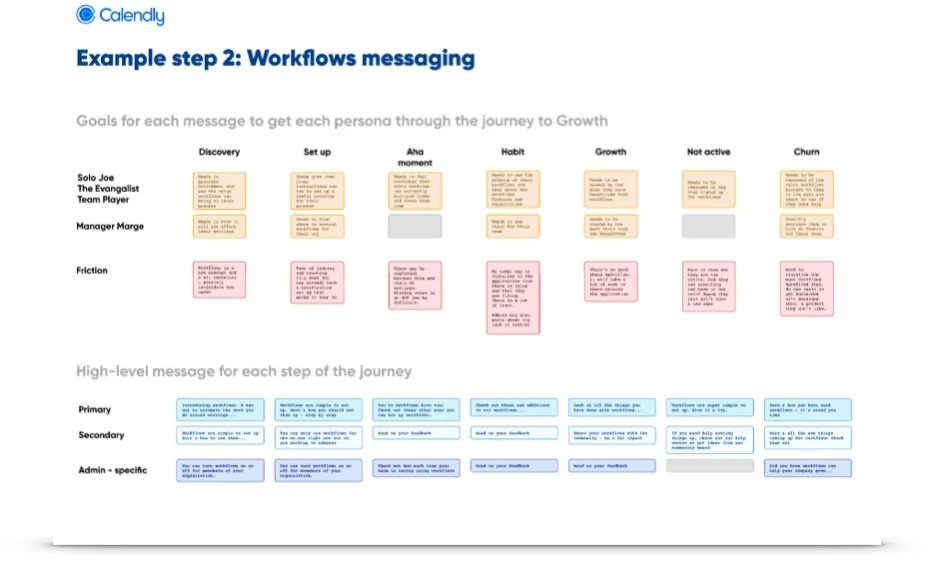
I designed a messaging funnel modeled on marketing demand generation
Instead of front-loading users with tutorials, I borrowed the awareness → consideration → conversion logic marketing teams use and applied it inside the product. Each touchpoint earns the next — influencing and informing rather than teaching — so we reduce cognitive load and friction on the way to the outcome.
6
I directed the team to write user stories before writing copy
We articulated what "excellent" looked like for a new user discovering Workflows — as narrative, not as features — so every piece of content we wrote afterward had a scene to serve.
“Meet Jeff the sales rep
One day while in Calendly, he’s informed that Calendly can automatically send email and text messages before, during, and after meetings.Jim finds this intriguing
Just last week he had 3 “no shows”. As a seasoned salesperson, Jim knows “the more meetings, the more deals”.Jim wants to understand how it works
So he watches a short video and learns all he has to do is answer a few short questions and he can test everything by sending the messages to himself!So Jim sets up a workflow…
He immediately receives an email confirmation message. The day before his “test meeting” he receives a text message, and the day after he receives a thank up email…just as he set up.Now that he understands and has confidence using workflows, Jim sets them up for all the types of meeting he offfers.”
7
We designed, wrote, and tested new experiences against the stories
The team built and iterated against the user stories as the success criteria — so every change had to move the narrative forward, not just look better on the Figma canvas.
8
We released in a measurable window and instrumented everything
I made engagement and setup completion the primary metrics content design would be judged on. We shipped, watched the numbers, and held ourselves accountable to them.
What shipped
Messaging that sets expectations and reinforces value before the user ever clicks in
Braze notifications on the home page that surface Workflows in-context, paired with a value-prop video
A landing page rewrite that leads with outcome, not feature mechanics
A "try before you upgrade" path that defused the subscription-gate objection
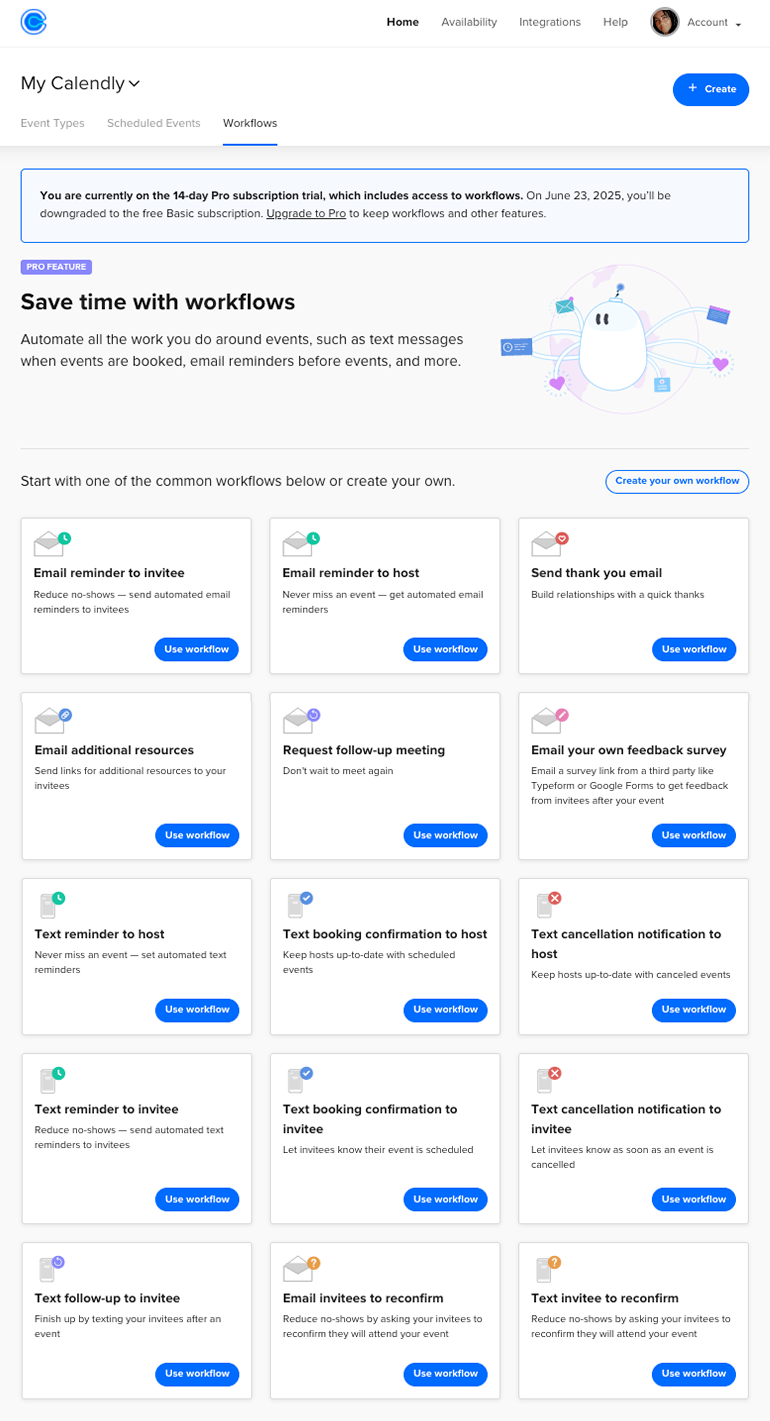
Pre-built templates with plain-language descriptions that compress setup and carry the mental model forward
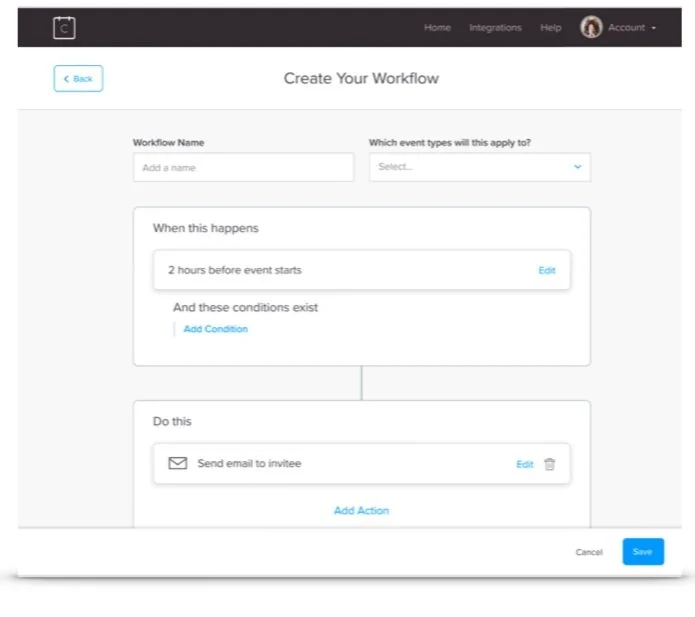
A new visual format for the anatomy of a workflow
Technical jargon stripped out at the concept level, not just the surface
Relationships between elements shown visually, so users build the mental model as they read
A variables explainer — because the most difficult concept deserves its own moment
Workflow video
What’s a variable video
The results, 20 days in
+65%
New users who tried Workflows
+47%
Setup completion rate
What this work says about how I lead
I don't treat content design as copywriting with better fonts. I treat it as a growth lever — a way to influence behavior at the same level marketing does, but inside the product, where the outcome actually happens.
I build teams that own outcomes, not deliverables — engagement, adoption, completion, not word count
I install repeatable operating models so the next launch doesn't need a rescue mission
I use storytelling as a research instrument, not a decoration — if we can't write the user's "excellent" as a scene, we haven't designed it yet
I hold content design accountable to product metrics and ship instrumentation alongside the work
Workflows is the proof point. The playbook is the product.